Tampilkan postingan dengan label my. Tampilkan semua postingan

Why Do My Dog’s Eyes Glow in the Dark


By Tamara McRill

Ever spot a pair of demonically glowing green or red eyes in the dark, only to realize they belong to your cute and cuddly dog? What really gets to me is when I’m the one outside and I see the floating bright orbs peering out my window. You know, it’s that split second where you’re torn between wanting to turn and run or bust in to save your pets from...whatever “It” is.

But of course, “It” is your dog’s (or even cat’s) eyes glowing in the dark. It turns out there is even a very scientific – and reassuring – reason their eyes shine so eerily in the darkness.

Tapetum Lucidum

No, that’s not the starting phrase of an exorcism, although it is Latin. It means “bright tapestry.” The words are also the scientific term for the light-reflecting surface between a dog’s optic nerve and retina.

The tapetum lucidum is what makes dog’s eyes react to light exposure differently than human eyes, essentially reflecting the light back through their eyes like a mirror. The rods and cones make use of the multiplied light to see better in the dark. Dogs and other animals with the structure, like cats and deer, can use very low levels of light to see.

Different Colors

In addition to superior night vision, this reflected light is also what produces eyeshine in dogs…that surreal colored glow that comes out in their eyes at night. What I find fascinating is that not every dog’s eyeshine is the same color.

My chocolate lab, Wuppy, has brown eyes that have a predominant phosphorus green eyeshine. One of our mixed breed dogs, Cody, has one blue eye and one brown eye. His eyes glow a dark red when hit with light in the dark, although the blue eye is more intense.

The colors of a dog’s eyeshine aren’t limited to red and green, either. They can be all shades of blue, orange, yellow, turquoise or even violet. The specific color reflected depends on the amount of zinc or riboflavin in the eye cells.

Red glowing eyes at night are the result of blood vessels reflecting light. This is common with white dogs who have blue eyes.

Some dog breeds are known for certain eyeshine color, although the tendency isn’t a guarantee that’s the color they’ll have. Yellow labs tend to have a light yellow shine, and black labs a deep yellow or green. Miniature Schnauzers are known for turquoise glow.

Outside Influences on Color

The eyeshine color can also depend on other factors, such as the kind of light being shined in a dog’s eyes. Headlights, halogen lights, flashlights and lights with colored filters may all produce a different glow in the eyes of the same dog. The intensity of the light is also a factor, as is the distance between the light source and the dog, and where you are standing in relation to the dog’s location.

I have photos of Wuppy where his eyes glow green. But in other photos, all taken during the same nighttime romp, the colors range from red and orange, to yellow.

You can often tell eyeshine color by taking a photo of your dog with the flash on, with them looking up at you. Just try not to get them right in the eye with the flash. If your dog is younger than 16 weeks, their tapetum will probably be blue or violet. The color of their glow may change as they get older.

What color do your pet’s eyes glow in the dark?

Photos by Tamara McRill

Read more articles by Tamara McRill
Read More..

Less Talk More Touch Whats Your Dog Saying to You

Guest post by: Erica Feuerbacher, PhD, of Carroll College Anthrozoology Program (Facebook)
via Flickr creative commons

Hi Mia and Julie,
 

Like you and your readers, much of my energy is devoted to my dogs’ happiness. I can identify a plethora of things they do that make me happy and I want to know what makes them happy; I explore this in my research. What types of human interactions do dogs prefer and under what circumstances? Knowing this might help us understand how to produce and maintain better bonds with our dogs. 

Two common ways of interacting with our dogs are petting or verbally praising them. My collaborator, Clive Wynne (@caninecognition), and I decided to ask dogs which of these interactions they prefer. 

Schematic and dimensions of the room arrangement for concurrent choice procedures. The drawing is approximately to scale and the room dimensions based on those of the room at the shelter.

We gave dogs a choice between two concurrently available options and measured whether they spent more time with one than the other—and how much more—as common way to measure preference. One assistant provided petting whenever the dog was near her, and another assistant provided vocal praise whenever the dog was near her. The dog was free to interact (or not interact) with either person for ten minutes. To test whether the dog really preferred the specific interaction and not just that specific person, we had the two assistants switch interactions halfway through the session. That is, the person providing petting switched to providing only vocal praise and vice versa. If the dog preferred petting in the first five minutes of the session, would the dog switch to the other person who was now providing petting? 


 Twinky, a shelter dog, receiving petting from the assistant on the left, but soon alternates to the assistant on the right who previously provided vocal praise but now provides petting.


We tested shelter dogs and two groups of owned dogs: in one group both assistants were strangers, which was the same as the shelter dogs, but in the second group, one assistant was the dog’s owner. This allowed us to test whether the owner providing these interactions would change dogs’ preferences.
 

Across the board, dogs preferred petting to vocal praise. This difference was most pronounced in shelter dogs (out of the first five-minute period, dogs spent an average of 3.5 minutes with the petting person and only 7 seconds with vocal praise person). This result, however, held up across groups, even when the owner was one of the assistants and even when the owner was the assistant providing vocal praise. Additionally, when the assistant providing petting switched to vocal praise, dogs left …some immediately! When they found the other person was now providing petting, they stuck with her. Dogs even left their owner when the owner switched to vocal praise! 


Patsy, a shelter dog, receiving petting from the assistant on the right but soon alternates to the assistant on the left who previously provided vocal praise but now provides petting. 
 
Dogs clearly prefer petting to vocal praise, but what if vocal praise was the only game in town? Maybe vocal praise is good as long as there isn’t something better available. We tested this by giving dogs only one alternative at a time and measuring how much time they spent when the person provided petting and when the person provided vocal praise. The results were the same: dogs remained with the person providing petting but spent very little time when that person provided only vocal praise. In fact, we found that dogs spent as little time with the person for vocal praise as when the person was ignoring the dog! To dogs, vocal praise was equivalent to being ignored. On the other hand, we also tested dogs that received eight three-minute sessions of petting and those dogs spent almost all their time with the person providing petting, even in Session 8. There was no evidence that dogs get tired of petting; as long as you are willing to pet them, they are willing to be petted!
 

Our results point to the importance of touch or our pets and for us. Petting is an easy way to relate to a dog and help build a relationship. One thing to note is that in our study dogs were free to approach or leave the assistant—that is we never forced the dogs to receive petting. So, as much as dogs like petting, don’t rush out and pet every dog you meet! You need to allow the dog to come to you to be petted and to leave when it wants. 


Scorch, an owned dog, receiving petting from the assistant on the left who is Scorchs owner. When his owner switches from providing petting to providing only vocal praise, he soon alternates to the assistant on the right, a stranger, who previously provided vocal praise but now provides petting.
 
It was surprising that dogs did not prefer vocal praise—even when it was the only interaction available. We often get the comment from people, “Well, my dog loves when I talk to him!” We have to remind them that we only praised the dogs whereas most people praise the dog and simultaneously do something else really fun (like petting). We also praised the dogs for a long time—as long as the dog stayed near the assistant. This is harder than it sounds and worth trying—a few dogs did spend a good amount of time with the vocal praise assistant and that poor assistant had to praise the dog for few minutes on end!
 

Now its your turn... Put YOUR dogs preferences under the Microscope
You can certainly do a mini version of our research at home: talk to your dog for an extended period without doing anything else—don’t grab the leash or pet him or reach for a treat. Does he stick around? Does he wander off? Dogs do learn to love certain words, like “walk,” “cookie,” or “good girl,” but those are only meaningful because they are usually associated with other good things—like going for a walk, getting a treat, or being petted.
 

What I enjoy about my research is it gives us the dog’s perspective and asks the dog, “what do you like?” rather than assuming we know what they like. Our results regarding vocal praise are really interesting given how much we talk to our dogs; perhaps all our chattering is more for us than for them and if you really want to communicate with your dog, you should try petting. 

~ ~ ~


Dr. Erica Feuerbacher joined the faculty of the Anthrozoology program at Carroll College in 2014, after completing her Ph.D. at the University of Florida in the Canine Cognition and Behavior Lab. Her research goal is to enhance our understanding of the dog-human relationship to improve the welfare of both.       
Further reading:
Feuerbacher, E. N., & Wynne, C. D. (2015). Shut up and pet me! Domestic dogs (Canis lupus familiaris) prefer petting to vocal praise in concurrent and single-alternative choice procedures. Behavioural processes, 110, 47-59.[Open Access PDF until Jan 2016]

Feuerbacher, E. N., & Wynne, C. D. (2014). Most domestic dogs (Canis lupus familiaris) prefer food to petting: population, context, and schedule effects in concurrent choice. Journal of the experimental analysis of behavior, 101(3), 385-405.

Feuerbacher, E. N., & Wynne, C. D. (2012). RELATIVE EFFICACY OF HUMAN SOCIAL INTERACTION AND FOOD AS REINFORCERS FOR DOMESTIC DOGS AND HAND?REARED WOLVES. Journal of the experimental analysis of behavior, 98(1), 105-129.

Udell, M. A., Lord, K., Feuerbacher, E. N., & Wynne, C. D. (2014). A Dog’s-Eye View of Canine Cognition. In Domestic Dog Cognition and Behavior (pp. 221-240). Springer Berlin Heidelberg.

© 2015 Erica Feuerbacher | Do You Believe in Dog?
Feuerbacher, E., & Wynne, C. (2015). Shut up and pet me! Domestic dogs (Canis lupus familiaris) prefer petting to vocal praise in concurrent and single-alternative choice procedures Behavioural Processes, 110, 47-5 - See more at: http://www.companionanimalpsychology.com/2015/01/do-dogs-prefer-petting-or-praise.html#sthash.hdkEDN4o.dpu
Feuerbacher, E., & Wynne, C. (2015). Shut up and pet me! Domestic dogs (Canis lupus familiaris) prefer petting to vocal praise in concurrent and single-alternative choice procedures Behavioural Processes, 110, 47-59 DOI: 10.1016/j.beproc.2014.08.019 - See more at: http://www.companionanimalpsychology.com/2015/01/do-dogs-prefer-petting-or-praise.html#sthash.hdkEDN4o.dpuf
Feuerbacher, E., & Wynne, C. (2015). Shut up and pet me! Domestic dogs (Canis lupus familiaris) prefer petting to vocal praise in concurrent and single-alternative choice procedures Behavioural Processes, 110, 47-5 - See more at: http://www.companionanimalpsychology.com/2015/01/do-dogs-prefer-petting-or-praise.html#sthash.hdkEDN4o.dpuf

Read More..

Why Does My Dog Do THAT

DYBID? gets to know a #NYC dog
Hi Mia,

Everything is different.

For the past two years I have been writing to you as you play out life in Australia -- “in the future” as I like to say. Others might call it a different time zone. To each their own. Now we’re sitting across from one another in my apartment working on our respective laptops as we prepare for #SPARCS2014.

Your arrival to #NYC has been such a breath of fresh air! Not only do we get to talk about our beloved topics of dog welfare, behavior, cognition, learning, training and everything-under-the sun-dog, but we get to do it while preparing to host an international TED-style canine science conference that anyone in the world can watch from their home!


One of the the things I enjoy so much about dog behavior research in general -- and Do You Believe in Dog? specifically -- is the feeling of community. There is a general perspective that researchers wear white lab coats and hole up in university laboratories muttering to themselves as they putter around with experiments until all hours of the night. While we might mutter to ourselves and putter around, the field of canine science very much has collaborative and collective elements. Researchers regularly meet to discuss methods, approaches and findings, and in recent years, scientists also share their findings with an increasingly interested audience. Science communication has become paramount in the field of canine research, and it would be pretty weird if dog science were all kept hush hush in academic research papers given its application.

For anyone who has ever wondered, “Why Does My Dog Do THAT (fill in the blank with whatever your version of ‘that’ is)," #SPARCS2014, a Free, Live Streaming canine science conference June 20-22, 2014 is for you. 

Since the inception of this blog, just under 2 years ago, we’ve had over 151,000 visitors. We look forward to seeing many of you virtually at #SPARCS2014!
  • To learn more about the SPARCS conference: http://caninescience.info/
  • Link to the Free Conference Live Stream: http://caninescience.info/live-stream/
  • Read about what will be covered: http://blogs.scientificamerican.com/dog-spies/2014/05/19/youre-invited-to-a-canine-science-conference-with-ticket-giveaway/
  • See who will be speaking: http://caninescience.info/speakers/
As we countdown to #SPARCS2014, here’s a sample of our preparations (with a side of playing with papier mâché dogs and greeting dogs).

Every dog deserves play!

We Work!

Cats are invited, too

Night!

Julie
Read More..

Dog Training Clicker


Clicker Dog Training

The newest dog training craze is clicker dog training. A clicker is a small rectangular plastic box with a metal button on top that clicks, hence the name clicker. It’s the type of training that the dog decides whether or not it suits him. There have been a lot of success stories with clickers, but with my dog he just didn’t want to know!

Researchers in dog studies believe that the clicker promotes enforced training, without punishment! As we all know when we do something good and get rewarded for it we are going to do the same again, a dog thinks the same way. Dogs learn through consequences, if they do something and it earns them a treat and praise they are going to want to do it again because they like this consequence. If they do something that you don’t like and they get ignored or said no to in a strict voice they know that they aren’t going to get any treats so are not going to do it again.

Clicker dog training works in such a way it reinforces good behaviour. If your dog sits, click and give him a treat. The next time he sits do the same but don’t say anything to him. He will soon realise that when he sits he will get a treat and hear a click, so when you eventually come to click before he sits he knows to sit. Its not all that confusing when you think about it.

Punishment is not used with clicker dog training as researchers believe that although punishment does stop some bad behaviour it may also create another unwanted behaviour. Punishment is almost always carried out after the dog has done something wrong so dogs see punishment as a random consequence therefore punishment doesn’t really solve anything.

Clicker dog training is not only used or dogs! It is widely used for other animals such as dolphins and horses. It is a widely practiced training method and does produce results; if carried out properly.

Some of the best quality dog resources and articles can be found online at MDarmas Dog Site. Our visitors recommend this website each time they try to search for dog training tips, advice and insider secrets from experts. You can search thru the form by keywords on that site or just browse their library of dog-related articles by experts in various fields of american eskimo breed dog.

Cheers

MDarma
Read More..

Is My Dog Dumb


By Langley Cornwell

Of course I’m not asking that question about my dogs; they are perfect. (Ha!). There is a certain dog I’m acquainted with, however, that doesn’t seem to be progressing as quickly as other dogs in a training class we, um, somebody I know is in. This person tells me that her dog is not motivated by treats or affection and is all but impossible to train.

So I went to my most reliable sources – my animal-crazed friends – for feedback about how their dogs stacked up on the intelligence meter.

Heather said her family tried and tried to get their dog, Toby, to roll over on command, but he would just roll over onto his back. She says it was frustrating trying to get him to roll completely over. Finally, thinking he just wasnt going to “get it,” they started rubbing his belly every time he “rolled over” onto his back.

According to Unleash Magazine, Heather’s dog isn’t dumb; her anecdote is an example of “profitable misbehavior.” Dogs do what works for them. For instance, if jumping on you makes you speak to, touch, or even look at your dog, he’s getting a payoff. Jumping on you is getting him the attention he wants. In cases like this, even if you are scolding your dog or pushing him off of you, he’s still getting what he wants: attention. This response can make dogs seem unwilling or unable to learn, but the issue is with the human who is unwittingly reinforcing undesired behavior.

Another reason people may think their dog is dumb is because he does not respond to them, perhaps due to lack of early human interaction. If I was to take a guess, I would say this is the core issue with our dog er, my friend’s dog because the dog spent his first year and a half in the shelter system and likely did not get enough time with humans. If a dog doesn’t experience enough human interaction during his formative years, he hasn’t learned that humans are relevant and that our words and actions should matter to him.

Cherise told me that for the longest time they thought their pooch was dumb. He never came when they called him or stopped what he was doing when they said “no.” They came to believe that he just wasnt eager to please them. I don’t know her dog’s background but maybe his disinterest is due to lack of early human interaction.

Unfulfilled needs may cause people to think their dog is dumb. Dogs have an innate need to play, exercise, bark, chew, and interact with other dogs. If these needs are not met in constructive ways, dogs will find unconstructive ways to fulfill these needs. They may bark inappropriately, chew your shoes or table legs, dig holes in your back yard and behave wildly indoors. Since standard corrections won’t solve the problem, your dog may seem dumb.

It’s also easier to train a dog to do something that is in accordance with his breed tendencies. In other words, it’s easier to train a golden retriever to retrieve than to protect. It’s easier to train a German shepherd to protect than to retrieve. Teaching a retriever to protect is possible but it will take him longer to catch on, and you may start to believe you’re working with a dumb dog.

If you think your dog is dumb, think about his background, age, breed and anything else that can clue you in on the best ways to communicate with him. Once you figure that out, load up on CANIDAE dog treats and commence training. You may be surprised at how smart your dog really is.

I received some other answers to my “dumb dog” question that I think are worth sharing, just for fun.

Kim: My Australian Shepherd ran headfirst into the fence at a full clip. Knocked himself dizzy. Seems he forgot to apply his brakes before trying to “herd” the nearby joggers.

Karen: We have a great watchdog, and I know when he barks it is a big deal. One day I noticed he was barking at the ground. Since he found a snake recently, I went to investigate. This time he found a cricket and was barking like the cricket was going to eat him.

Laurie: Not so much “dumb” as perhaps blind. Our 80lb. Rotti/lab mix was enjoying a lovely morning walk at the park when her hackles went up, deep growling ensued followed by ferocious barking. My husband and I quickly realized she was protecting us from a tree stump! What a good dog!

Mary Mac: During Hurricane Hugo, I had two dogs that slept through the storm, but when there was no power the next night they stayed up all night barking at dry leaves blowing across the driveway.

Jaipi: Our dog barks at blowing leaves. Then she runs away from them. Then she comes and gets me to show them to me. Im not sure what she expects me to do about it, but clearly, she wants those leaves gone.

Beaucee: We were staying at a vacation house that had sliding glass patio doors, something we didnt have at our house. We had the screen portion pulled shut, and sure enough, Tundra walked right into it, thinking she could walk out onto the deck. We snickered softly, not wanting to embarrass her. Of course her “daddy” did the same thing the next day.

Crystal: My dog seems a little dumb at times. Okay... he seems a lot dumb! Ive offered treats, and he has tried to eat them with a toy in his mouth. He will sniff the treat on the floor, and it’s obvious he’s trying to figure out how he is going to eat it. Finally, he puts the toy down to eat the treat.

Gayle: Our dog lives to play fetch. One day he was really into it. I threw. He returned as fast as he could to drop it in my lap. He returned faster with every throw. Finally I threw it high and long. The dog caught it and came back with lightning speed. He came flying up, touched his nose to my lap and darted off to catch it again. When he realized that the ball was still in his mouth, he tip-toed back and very gingerly dropped it in my lap.

What “dumb thing” does your dog do?

Top photo by Joe Dyer
Bottom photo by Lulu Hoeller

Read more articles by Langley Cornwell

Read More..

How To Calm My Hyper Dog

Fired Up, Frantic, and Freaked Out: Training the Crazy Dog from Over the Top to Under Control


Are you wondering How To Calm Your Hyper Dog? I believe I can help! First, ask yourself why do I have a Hyper Dog? The answer to this is usually, too much pent up energy. With our busy lives, dogs are usually left home for most of the day with nothing to do. They get bored. By the time you get home, they are ready to GO!

This is when they are super excited, jumping all over you, bolting out the door, and most people see this as a Hyper Dog. Wouldnt you be excited and ready to go after a boring day at home with nothing to do? No TV, no Computer, No books to read, nobody to talk to, nothing to play. It would be like sitting in a prison cell all day.

Here are some tips for you to calm your hyper dog.

How To Calm My Hyper Dog : Mental Stimulation


What is Mental Stimulation, and how will this help you calm your hyper dog?

Mental Stimulation is getting your dog to think and work. You can do this through games, Interactive Toys, or Puzzle Toys.

Games can be things like; Hide and Seek or Find It. If youre wondering how to play these games with your dog, ask in the comment section and Ill be happy to teach you.

Interactive toys are toys that you put food or treats in to let your dog work at them to get their food out. Read more about Interactive toys in my article Interactive Dog Toys: Where To Get Them, Good Ways To Use Them

Puzzle Toys are puzzles made specifically for dogs. They come in all different shapes, sizes, and difficulty. You put treats or food in them, then let your dog figure out how to get the treat out. Usually, these toys need you to be supervising while your dog works at them. Dogs may need help getting started with these till they get the hang of it.

All of these will be mentally stimulating and will help tire your dog out. Work their brain and its a whole different kind of tired. Its the difference between us reading a book or working at a puzzle, or going out and running for 30 minutes. Consider these as giving your dog TV, Books, and computer time.

How To Calm My Hyper Dog : Physical Exercise


How will Physical Exercise help you to calm your hyper dog?

Providing a place for your dogs energy to go is a must. Just like you or your kids, your dog needs to have an outlet for their pent up energy. If you dont provide it, then you get what youve got, a hyper dog.

Here are some ideas to get you going; Walking, Running, Biking, Rollerblading, Fetch, Frisbee, & Swimming.

Anything that gets your dog moving and getting that energy out is going to help you to calm your hyper dog! If you have a place to let them run off leash, this is going to be the best for them. This does NOT include your yard. Your yard is just an extension of your house. Its like being in prison and them letting you out into their yard. Would you feel free? Would you feel satisfied after exercising out there?

How To Calm My Hyper Dog : Training


Training can provide both Mental Stimulation, and Physical Exercise for your hyper dog. If you add in play time such as a tug on a rope, or a quick toss of the ball as a reward, then this would be physical.

Obedience, and tricks will help with the mental stimulation. If you train for Agility, Flyball, or even Bird Dog Hunting, these will all help with physical exercise as well as mental stimulation.

Youll find training and working with your dog to be a huge help in calming your hyper dog! Not only will it help you calm your dog, but it will also help you bond with them too.

So, what have you learned today? Lets recap. Provide your dog with Mental Stimulation, Physical Exercise, and Training. Your Hyper Dog will soon be your Calm Dog!


Enjoy! If you found this blog post helpful, please comment below and share it with your friends.

If you need further help than this post this Book will be beneficial for you and your dog.

Image Credits:
Top Pic - Cobalt123 @ Flickr
Bottom Pic - StuartDootson @ Flickr

Amy @ Talented K9
talentedk9@yahoo.com
www.talentedk9.com

Read More..

Case File Help! Is My Dog a Threat to My Crawling Baby

We got an email from a parent, with concerns about her newly crawling baby and her two dogs.
Dear Doggone Safe: We have two dogs: one is a certified therapy dog and one is a rescue coon hound. We had a baby this summer and she is 8 months old now and starting to crawl. We have researched information before she was born about dogs and babies. And we have set up gated areas and dog safety protocols in our house. Always supervision etc.  But I have a question that I cant find an answer or help with..... My daughter likes to crawl now - everywhere- and even when the dogs are sleeping on their dog beds she tends to crawl right to them and wants to touch them -their tails, faces, ears etc. I am a first time mom - so I redirect her to something else... say no.... when we are holding her we allow her to pet our therapy dog on her side/ back etc., to try to show her the correct way... although she is very young still to understand. I am just not sure how to teach her at this age how to give the dogs space and respect. Is what I am doing correct? Should I be doing more?  Is it just a matter of constant redirection of her to something else when she crawls to the dogs? Even our therapy dog gets annoyed after awhile of course. I dont want to have to ban the dogs from the living room completely I just need some advice or reassurance of what we are doing so we establish good behaviors from both our daughter and our dogs. Thanks for any help you can give me!
We passed this question on to our dog and baby expert, dog behavior consultant Jennifer Shryock. Jen will of course offer one on one consulting to make sure and get all the details so that she can offer help, but there are probably many others who have the same issues.

If you have a newly crawling baby, you know that your life has become much more complicated! No longer does the baby stay where she is put, contentedly watching from the safety of a play pen or other piece of baby apparatus. Now the baby is mobile and she wants to explore and interact with everything, including the dogs. Now you find yourself following the baby around and finding out that even though you thought you had thoroughly baby-proofed, there are sill hazards that the baby will undoubtedly uncover.

There is no such thing as a 100% baby-proofed dog. No matter how sweet and gentle your dog is, there comes a point where he will not tolerate any more from the baby. Hopefully at this point he just relocates to a safe area that you have provided for him, but he may decide that he has no choice but to growl or bite if the baby persists.

Jennifer Shryock gives this advice to parents of crawling babies:
At this stage moving babies look quite different from other humans and most dogs are uncomfortable. This period is a time of intense management and setting up parent guided interactions.  I use the phrase "invites decrease frights and bites"  as crawling babies  approaching a dog makes dogs uncomfortable and is a leading cause for injury at this age. 
Here are two prerecorded webinars produced by Jen that will help answer many of the questions that parents of crawling babies often ask:

Webinar presented to the Association of Pet Dog Trainers

My Dog Growled at My Baby... Help!:


For more information or to arrange a consultation please visit Family Paws Parent Education

Read More..

Positive Pet Training Blog Hop Active Dogs Parkour and Stretching and Conditioning Equipment Oh My!

Hey, everyone!

Thank you so much for all the wonderful, kind, and supportive comments on our new addition! Rule, as she has been christened, says thank you.


Today Im participating in the Positive Pet Training Blog Hop, hosted by Rubicon Days, Tenacious Little Terrier, and Cascadian Nomads. Januarys theme is "National Train You Dog Month", and as always, any positive-based training posts are accepted.


I debated on doing a sort of "Plans for 2016" training post, but quickly dropped the idea in favor of something Ive been really enjoying lately, and something that I feel is invaluable to those of us with active dogs, or any dogs, really!

Whats that, you ask? Fitness, and how to keep your dogs body strong and healthy!

2015 was my year of getting fit and healthy. I quit sugar in late December of 2014, and aside from yogurt, peanut butter, and natural sugars like fruit and honey, havent had any since then. Ive kept up with yoga 4-7 days a week. I started running and walking, and have been consistently doing 5 to 10 miles a day. I quit gluten, Im careful with getting enough sleep, and eat incredibly healthy.

I had one small cold in October, but was otherwise 100% healthy. In the years before, Id be sick 5+ times a year. My moods are stable, my skin is clear for the first time in my life, I feel amazing, and I am so happy. I cant imagine its much different for our dogs!

Having a fit and healthy dog has always been a top priority of mine. The vast majority of dachshund owners do not exercise their dogs, leading to overweight dogs and more back problems than you can shake a stick at. I refuse to have that for my Doxie girls, or Pike or Rule. Aside from a good diet, exercise is one of the best tools for a healthy dog. These are some simple, fun training activities you can do with your dog to help increase strength, balance, flexibility, and overall stamina.

Disclaimer: Know thy dog. These exercises are preformed by young, healthy dogs with no medical problems. Be careful!


Parkour

Something Ive become a little obsessed with lately is Parkour for dogs, or "Barkour", as it is sometimes called. Parkour training is a way of using your environment as an obstacle course, involving climbing, jumping, running, vaulting, ect. Its the same thing for dogs! 
I like it because you dont need any fancy equipment (Im cheap!), and anywhere you go can offer different challenges for you and your dog. Everything from trees to fences to picnic tables to playgrounds can be used! You can even earn titles in the sport from The International Dog Parkour Training Association. I may try both Nola and Rule for these soon. 


I only started the girls on this about a week and a half ago, but already theyre picking it up and loving it. Its Nolas favorite time of day! 

Some cues used in the below photos:
Paws Up! (front feet on object)
Up! (jump onto object)
Pretty (sit pretty/beg)
Stand (stand on hind legs)
Climb (self explanatory) 
Up on here (walk along an elevated surface)
Working on climbing on cue! #positivedogtraining #dogtraining #smartdog #climb #dailydog #dachshunds #dachshundnola #dachshundsofinstagram #dogstagram #dogsofinstagram #trainyourdog
A video posted by @dachshund_nola on


Climbing over an obstacle 

Were working on going under, too!
Climbing up

Climbing down 

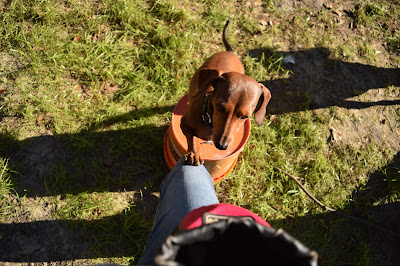
Up on a bucket

Up on a cinderblock 


Increasing difficulty by having her back feet on the bucket, and her front on my leg. 


Climbing 


Standing up on a cinderblock. Bonus core and rear workout!

Shes such a happy dog!

Balancing on a narrow board

Paws up

Jumping off

Using a tree to show off "paws up!"

Now the other side!

Rear end awareness on a hunk of lumber. 

Paws up

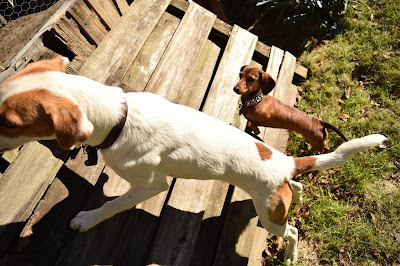
Balancing on a narrow walkway

Tandem paws up!

And again!


Stretching

Any athlete, human or canine, needs to have warm ups, cool downs, and stretches. Warming up literally warms and ready the muscles and sinews for activity. Cool downs allow the body to work out  lactic acid, prevents stiffness and soreness, and lets the heart and respiratory rate to return to normal. Stretching helps to maintain flexibility and fluidity, allows blood to better circulate, and greatly reduces the risk of injury. 
I do all three of these with the girls before a Parkour session, before a run or long walk, before an intense play session (especially tug), and before working on physically demanding tricks.

For cool warm ups and cool downs, Ill have them do a few sit/down/stand/repeat drills, a quick brisk walk and/or backing up or other rear end awareness exercises. It only takes a few minutes, and helps to get the girls into a training mood.

For stretching, I follow the things listed here. Theyre easy to put on cue!


Conditioning: Poses and  Equipment

There are a few great poses your dog can learn to help build muscles. Sit pretty (or beg) is fantastic for building core strength. I do this one a lot with Nola; having a strong back and core reduces the risk of back issues. Standing on the hind legs builds both the rear muscles as well as balance. Holding positioning, or changing position, on some kind of balancing equipment not only builds balance, but also overall strength.


Two great resources on Facebook are Canine Conditioning and Body Awareness, and Structure in Motion - Too!


Im a sucker for dog gear of all kinds, and fitness and conditioning gear is no exception. Currently we only have a FitPaws donut, but this month Im planning on ordering several others, including:

Paw Pods


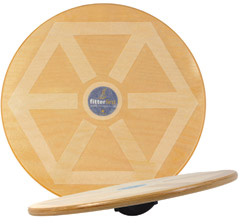
Balance Disc


Peanut 

Wobble Board


Since Im cheap, Ill be buying the human version of these (and perhaps having my dad make a wobble board). Half the price and just as sturdy!


Nola and Rule also do 3-5 miles of walking and about a mile of running a day with me, in addition to play, with both me and all the dogs together. Those two are both high energy dogs, while Pike and Olivia lean more towards moderate and low, respectively.

Keeping your dogs in good body conditioning also greatly reduces the risk of injuries. Nola and Rule score as 4s on the Purina body condition chart, where Pike is a 5 and Olivia a 4. Its hard to see on Pike and Liv due to their coats, but you can see it well on the smoothies.
This one shows the muscling on both girls. 

Nolas admirable rear. 

Rule is naturally thin and narrow. 

Nolas waist

And again


How do you keep your pup fit?

- Dachshund Mommy


Read More..