Tampilkan postingan dengan label what. Tampilkan semua postingan

Do You Believe in Dog One year of believing

Happy anniversary Julie!

Can you believe weve been exchanging blog posts about canine science for one year already? In some ways its gone so quickly and in others its hard to remember when we werent. I was going to do a highlights kind of post, but decided its all been so freaking fantastic, that I wouldnt know where to start or stop.

In all ways, its FABULOUS, and I thank you from the bottom of my everything for answering my first blog post with a big, fat YES!

#AAWS2013
I attended the 7th National Workshop for the Australian Animal Welfare Strategy this week. It was a busy few days with lots of learning and networking going on, everywhere you looked.

Stand out things you should know about:

AMRRIC do AMAZING work in rural and remote indigenous communities. You can follow them on Facebook, on YouTube and/or sign up for their newsletter. Check out details of their upcoming conference.


After calls for an independent office for animal welfare in Australia, minister Joel Fitzgibbon announced at AAWS2013 he is creating the role of Inspector General for Animal Welfare & Live Exports. This has been met with mixed reactions from the two main groups (primary production and animal advocacy bodies) involved. As we will be having a federal election very soon in Australia, it will be interesting to see what happens on this front in the coming months. The sceptics suggest, "not much".


Im now taking a weeks break with my family in sunny Queensland - much warmer than my home town right now. I hope you are enjoying your Summer. 
What have you been learning at all those conferences?

Thank you once again, for a year of believing in dog with me!

Big hugs,

Mia
© 2013 Mia Cobb

Read More..

What is Dog Water Therapy

By Tamara McRill

Who can resist the joyous tongue-lolling grin dogs get when they play in water? Not me… and Im guessing that as a pet lover, not you either! Turns out this canine fun – in the form of dog water therapy – can also help the health of our pets.

Sounds like a great match, so lets explore just what dog water therapy is, what you can expect and how it can help with pet rehabilitation.

Splish Splash

Well, its sort of like taking a bath. Dog water therapy – also known as canine hydrotherapy – is most commonly performed in a small heated pool. A dogs muscles are similar to ours, in that they can benefit from the warmth of heated water. Most hydrotherapy pools are also treated with a chemical such as chlorine.

Most therapy center pools have either a ramp for dogs to get in and out of the pool, a hoist to lift your dog out, or both. If your dog has difficulty walking, be sure to ask about this at centers you are checking out.

Some pools also have jets to spray underwater, which is great for building strength. Also something to ask about, if it meets your dog’s medical needs. Always be sure to consult with your veterinarian before starting any type of therapy for your dog and to get your vets recommendations on what types of pool features are best for your pets treatment.

When to Consider Water Therapy

There are a broad range of canine health problems that can benefit from hydrotherapy. The most common are chronic conditions, such as:

• Hip/elbow dysplasia
• Mobility problems
• Joint injury
• Spinal injury
• Geriatrics
• Chronic pain
• Arthritis

Hydrotherapy can also help our furry friends before and after surgery. Overweight dogs can also get more exercise, without the stress to joints, during water therapy. There are also those dogs that go just for fun.

Jump On In

If you think you would enjoy spending time in the pool with your pooch, there are some centers that allow this. Be sure to ask ahead of time though, and ask what to wear! This is also a great idea for pets who become overly nervous in new situations.

Just a word of caution: If you become nervous while in water, then you may want to skip getting in. Your unease could transfer to your pet and make the sessions stressful for them.

Questions to Ask

There are several things you will want to ask any hydrotherapy clinic before taking your dog there for treatment. This will help you determine what is the best fit and if the center is safe. Some of these include:

• How much training does the person giving the treatment have?

• Do they know pet first aid – especially in an aquatic situation – and have they ever had to perform it?

• Is there a vet on-call for emergencies?

• Will you be allowed to attend the session?

• Is the facility insured?

Also see if they will give you customer referrals to check up on. If at any time the center makes you uncomfortable about leaving your precious dog in their care, dont be afraid to skip them.

Most of all, try to have fun with the experience and make sure your dog has a wonderful time, too. You can do this by bringing along some healthy dog treats like CANIDAE Pure Heaven as a reward, staying calm and talking to your pet in a positive voice.

Have you ever tried canine hydrotherapy for your pet?

Top photo by Ordinary Guy
Middle photo by feeferlump
Bottom photo by Phiz

Read more articles by Tamara McRill
Read More..

What is Impulse Control in Dogs

Keikei
By Linda Cole

I didnt really understand what impulse control was until our dog Keikei came to live with us. She was an adorable and happy 8 week old puppy who quickly adjusted to us and the other dogs. But as she grew, she became overly excited to go outside. By the time she was 4 months old, her excitement escalated to a point of no return, and she was easily agitated. She was the perfect example of a dog that needed to learn impulse control.

In our world, impulse control is delayed gratification, resisting an impulse for immediate satisfaction of a desire or temptation. Instead of spending your entire paycheck on an expensive vacation package, you spread the cost out over time to lessen the financial impact on your wallet. Your budget for this month is tight, so you skip the Friday nights out so you can pay the bills. We learn as children that no matter how much we might want something right now, whether its a new toy, going to a concert or staying overnight with a friend – immediate desires or wants dont always happen. So (hopefully) we learn early on the need for impulse control.

Controlling a puppys impulse isnt difficult because of their smaller size, and most pups can be picked up to stop an unwanted reaction to something they want. If your terrier puppy finds a chipmunk hole in your prized flower bed, you can pick him up to stop him from digging, and then figure out how to humanely relocate the chipmunk without ruining your flowers. But depending on a pups age, not all puppies can be picked up to control an impulse. Thats one reason why its important to start puppy training as soon as you bring him home. Unfortunately, as a pup grows up, he becomes more independent and if you didnt teach him at a young age how to control his impulses, his unwanted behavior will remind you of the importance of dog training. A dog that obeys basic commands is easier to control, and that is one way you can keep him safe.

All dogs should know how to sit, come, drop it, leave it and stay/wait. Teaching your pet is something you have to make a commitment to do, and starting when your dog is young helps you ward off bad behavior as he gets older. You might be surprised to discover how quickly dogs can learn. Some canines are free thinkers, some are more stubborn and some are sensitive, but all dogs can learn if you commit to their training. The Border Collie sits at the top of the list of smartest dogs, not because they are the Einsteins of dogs, but because they only need a few repetitions to learn something new. The Bloodhound is close to the bottom because it takes many more repetitions for him to catch on. Its our job to find out what motivates our pet to learn. Dog training is a process that requires patience, as well as understanding who your dog is as an individual.

Teaching a dog to sit and wait is one of the best ways to help him relax and learn impulse control. A dog who grabs a CANIDAE treat from your hand or practically knocks you over trying to get out the door is telling you he doesnt understand how to control himself. His excitement to get what he wants right now causes unintended bad behavior. You can change his behavior by having him sit calmly to get what he wants so he learns to control himself. Sitting patiently has an added advantage and helps him learn to focus on you to find out whats next, which is one way you earn your dogs respect and leadership role.

Start slow, be patient and calm, use positive reinforcement and give your dog plenty of opportunities to be successful. Once he learns a command, practice it daily. Keikei learned her commands very quickly, especially sit and drop it, and shes extremely responsive when learning something new. If she has trouble containing her excitement when going outside, putting her in a sit/stay calms her down and makes it much easier to control her desire to herd the other dogs down the steps and out the door. Working with her to control her excitement also gave me an opportunity to teach her how to wait.

Dogs dont understand what impulse control means. To them, everything they do is natural behavior, and the only consequence is not getting what they want sooner. As responsible dog owners, its up to us to help our dogs learn to suppress natural desires, like herding anything that moves, digging up a flower bed or chasing a squirrel. Keeping their excitement under control is how you keep your dog safe, and it keeps other pets, property and people safe, too.

Read more articles by Linda Cole
Read More..

Black Dog Syndrome A Bad Rap

Hi Mia & Julie –

Firstly, thanks so much for letting me drop a verse in the rap song of your blog! I feel so awesome being featured. It’s like being Lil Wayne or something. Anyway…

I’m just recently back from ISAZ 2013, where I had a most excellent time chatting with other anthrozoologist-y types. 

As you know, I just graduated from the Anthrozoology Master’s Program at Canisius College, so I was uber-excited to have a chance to share my research with colleagues in the field. ISAZ did not disappoint. 

Pauleen Bennett & Heather at ISAZ 2013
Now I get to share with you two and it just gets better and better! :-)

My master’s thesis research project (advised by the oh-so-awesome Christy Hoffman) looked to answer the question: “Does Black Dog Syndrome Exist?

Animal welfare folks are probably familiar with the concept of Black Dog Syndrome (BDS) that Julie introduced last week: it’s the idea that dogs with black coats have a harder time than other dogs getting adopted, and as a result, may face higher rates of euthanasia and longer stays in adoption programs


Popular media - but is it correct?
A lot of popular media articles focus on this concept (like here, here, here and here) but the research results have been mixed: in a study published earlier this year, participants rated an image of a black dog as significantly less agreeable, less conscientious, and less emotionally stable than a yellow dog (Fratkin & Baker, 2013). Yet research into factors influencing shelter dogs’ lengths of stay (LOS) found that LOS was not significantly correlated with coat color (Brown, Davidson, & Zuefle, 2013; Protopopova, Gilmour, Weiss, Shen, & Wynne, 2012).

To dig deeper into the questions of whether potential adopters discriminate against black dogs in a shelter and whether black dog discrimination is reflected in shelter stats, I conducted a two-part research project:

Shelter Visitor Pilot Study – examined interaction between potential adopters and shelter dogs

Shelter Data Analysis Study – investigated relationships between LOS and coat color, age, sex and breed, as well as the impact of these variables on likelihood of euthanasia

And what I found may surprise you.
There was very little evidence to support the concept of Black Dog Syndrome!

From Heathers ISAZ 2013 poster

I know animal shelter workers are going “WHAT!?” right now – I know because I AM a shelter worker – but the truth is, even if many potential adopters come to the shelter with a negative bias toward black dogs, it’s not resulting in crazy-long shelter stays or greater risk of euthanasia for black dogs. In fact, according to analysis of shelter statistics, black dogs were adopted out faster than average at both shelters in my study. Black dogs were also less likely than expected to be euthanized (good news for black dogs, eh?).

When shelter visitors video-recorded their walk through the adoption area, I found that they spent about equal amounts of time looking at every dog, regardless of coat color. Visitors also rarely made specific comments with regards to coat color, although one guy did say: “I like black. Black dogs are cute.” Interactions like petting or feeding dogs also occurred as frequently between visitors and black dogs compared to dogs of other coat colors.

Still, I can’t deny that a few different studies show that people rate images of black dogs more negatively than other colored dogs. That being so, can I really say there’s no such thing as Black Dog Syndrome? Well, I think there’s evidence for a negative bias against black coats when viewing still images of dogs of different coat colors. However, this bias just isn’t impacting the adoption rates or in-person interactions with black shelter dogs. Granted, my video study sample was very small – it was a pilot study, after all – but the shelter stats were quite clear (and my sample there included 16,000+ individual dogs).

So, yes, I’m saying Black Dog Syndrome ain’t no thang. Like, really, it’s not a thing. 

But I certainly am open to the idea of a Black Dog Bias, and I think that’s the next step for this type of research – teasing out whether preconceptions are truly influencing adoption decisions. 

My head’s swimming with ideas about how to do this and if anyone is working/has worked on this kind of research, I’d love to hear from them!

Thank you ladies for giving me the mic.
Now picture me dropping it on the floor without a care. 
Svo. Out.


No really, you two are super RAD. Keep doin’ what you’re doin’! 
And thank you for letting me be a part of it.

Heather Svoboda, MSc
Communications & Development Manager, Cat Adoption Team
Infrequent Blogger, Anthrozoologist Real Gosling // Reasons My Cats Are Sleeping

Further reading:
Brown W.P., Davidson J.P. & Zuefle M.E. (2013). Effects of Phenotypic Characteristics on the Length of Stay of Dogs at Two No Kill Animal Shelters, Journal of Applied Animal Welfare Science, 16 (1) 2-18. DOI: 10.1080/10888705.2013.740967

Fratkin J.L. & Baker S.C. (2013). The Role of Coat Color and Ear Shape on the Perception of Personality in Dogs, Anthrozoos: A Multidisciplinary Journal of The Interactions of People & Animals, 26 (1) 125-133. DOI: 10.2752/175303713X13534238631632

Protopopova A., Gilmour A.J., Weiss R.H., Shen J.Y. & Wynne C.D.L. (2012). The effects of social training and other factors on adoption success of shelter dogs, Applied Animal Behaviour Science, 142 (1-2) 61-68. DOI: 10.1016/j.applanim.2012.09.009

Svoboda, H.J. & Hoffman, C. (2013). A novel empirical test of Black Dog Syndrome. Poster. International Society for Anthrozoology (ISAZ) Conference. July 18-19, Chicago, USA.

© 2013 Do You Believe in Dog?

Read More..

What You Know About Your Dog But Dont Want To Talk About!


When you’re certain in getting a dog, Ill bet you dreamt about the countless times youd have with your new best friend. Nonetheless, there are things that you need to deliberate in order to keep your pooch healthy and happy. Things that possibly youd rather not even think about!


 When you visit your veterinarian he may request you to bring a urine sample from your dog. How do you do this? Your dog confidently wont be able to hit a sample bottle. The coolest way to complete this is to tape a polyethylene vial to the end of a yard stick. While your dog is playing, position the container beneath his urine stream.

 This is stress-free to do with male dogs than female dogs but you can habitually get a tester with one or two tries. Your veterinarian will need as fresh a sample as thinkable so if you wont be compiling the sample to the vet right away, keep it chilled until you bring it in. Your veterinarian will be examining the sample for a range of stuffs like bacteria and crystals. If bacteria are found it possibly will mean that your pooch has a urinary tract infection and will most probable necessitate your dog to be put in a sequence of antibiotics. Crystals form in the urine when minerals bind together, there are numerous different kinds of crystals and these are peak often treated with prescription diets.

If your veterinarian requests for a stool sample it might mean that he doubts that intestinal parasites are troubling your dog. They can acquire these by eating fecal matter from carcasses, unsavory things and another affected animal. You will want to get in a fresh sample. The doctor will inspect it under the optical microscope and look for telltale eggs of parasites. Commonest parasites are roundworms, roundworms, whipworms, hookworms and tapeworms. Several of today’s regular heartworm treatments also protect against hookworms and roundworms. If you’re living in the country where your dog stays outside for much of the day, he may prerequisite to be cured with a tapeworm wormer on a trimestral basis. Other diseases alike coccidia, can also be seen under the optical microscope from your dog’s stool sample.

So, now you can discuss about those unpleasant things! Its imperative that you are accurately educated and can identify signs and symptoms so that you keep your dog as in fine fettle as he can be.
Read More..

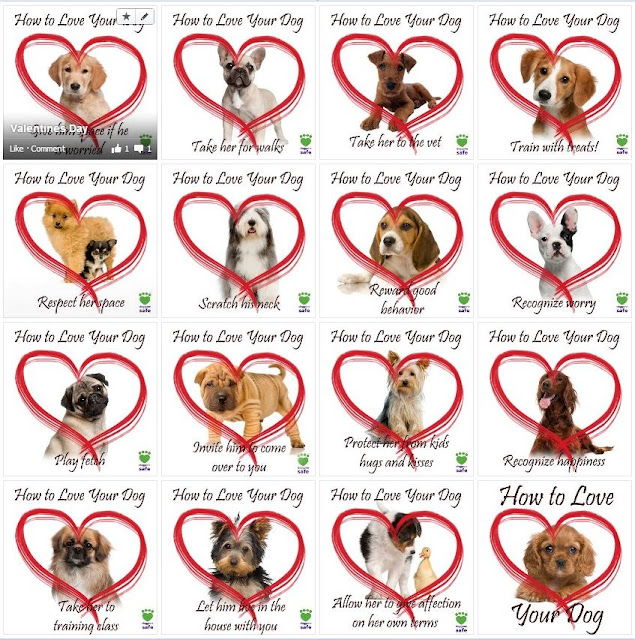
What Does Your Dog Really Want for Valentines Day

If we had to guess, we would say he wants your love. There are lots of ways to show that you love your dog:


View these and share on Facebook

View and repin on Pinterest

View and retweet on Twitter

View and share this video: Teach My Person How to Love Me


Train your dog the force-free way using positive reinforcement. Heres how that should look:


Read More..

What music do dogs prefer Bach vs Snoop Dogg

Hey Julie,

I hope youve had a fun week.

I saw a new in-press publication with your name on it - "Smelling more or less: Investigating the olfactory experience of the domestic dog" - looks like a really great study, and so timely after my last post about dogs and olfactory enrichment

Looking forward to reading it (and all those other cool Learning and Motivation articles) over the weekend.

So did you do your homework? Did you watch this clip from the Sydney Opera Houses Ship Song Project


I wanted you to watch this clip, and more importantly, LISTEN to it, because it features lots of different musical styles. I dont know about you, but I certainly have a different reaction to the different styles. Some appeal to me more than others. Some I find relaxing, while others make me want to nod my head to keep the beat or even hum along.  I was talking about this clip recently with my friend Mark (from SARC, in my head that always runs together "Mark-from-SARC") and of course we shifted to talking about dogs and music. As you do. Thats normal - right?!


What kind of music do dogs prefer?

As part of my PhD research into kennel enrichment, I looked into this very question. 
The research in this area has been conducted in two kennel environments.  


Headphones on dog = silly (they hear around x4 better than us!) source
In the first study, scientists played five different recordings to dogs housed in a shelter kennel: 


- a control (nothing) 
- human speech
- classical music
- pop music
- heavy metal music

to the dogs and recorded the behaviours of the dogs using an ethogram. Then they looked at the differences in the behaviour of the dogs during each condition.
 
The dogs were significantly more likely to run around barking when the heavy metal music was played; and lie down, apparently resting quietly, when the classical music was on. 

There was no difference to their behaviour when the control, human speech or pop music were played. The second study showed similar results, with classical music linked to more sleeping and heavy metal correlating with more body shaking.
(source)
Its probably worth noting that these changes in behaviour may not reflect dogs actual PREFERENCE for music. To assess that, wed need to set up a study design that offered dogs a choice of multiple sound environments. But it certainly suggests that if we want to encourage behaviours associated with relaxation, like lying down, not barking, and sleeping; we should be piping some gentle classical music to the environment our dogs are in. I reckon my dogs quite like Chopins Nocturnes, but maybe thats just me.

The Australian ABCs fabulous science program, Catalyst, have a great (~6min) story about this research that you might enjoy watching here.


(cant embed their vid, but click this pic to go to video)
Have a great weekend, I look forward to hearing what else is going on with you now those students have been set free!

Mia

Further reading:

Hubrecht, R. C. (1995). The welfare of dogs in human care. Chapter in Serpells book: The domestic dog, its evolution, behavior and interactions with people, 179-198.

Kogan L.R., Schoenfeld-Tacher R. & Simon A.A. (2012). Behavioral effects of auditory stimulation on kenneled dogs, Journal of Veterinary Behavior: Clinical Applications and Research, 7 (5) 268-275. DOI: 10.1016/j.jveb.2011.11.002 

Wells D., Graham L. & Hepper P. (2002). The influence of auditory stimulation on the behaviour of dogs housed in a rescue shelter., Animal Welfare, 11 (4) 385-393. Other: Link

© 2013 Mia Cobb
Read More..

Tip of the Day Dogs Dont Like Hugs and Kisses What !

A different kind of love


One of the most important things you can teach your children is that dogs dont like hugs and kisses. This is a tough lesson, because many (if not most) dog owners simply do not believe it themselves.

Children learn early on that giving hugs to parents, siblings, and stuffed animals is a way to show love and affection. The desire to show affection extends naturally to the family dog. To a child, the family dog is just an animated stuffed animal.

Sadly, this desire to show affection to the family dog is a major cause of facial bites to children. Dogs may tolerate hugs from kids, but few actually enjoy this type of attention. If a dog does more than tolerate this inappropriate handling, it is only on the dog’s own terms—when the dog comes to the child for attention, and only if the child does not hug tightly or hang on too long. There is no dog that loves hugs from kids anytime, anywhere, anyhow.

Teach children to pet with one hand and to wait for the dog to come to them for attention and then to leave the dog alone if he moves away.

Listen to the experts, including the dogs!


How do we know this? In part it is because every dog behavior expert tells us so. For example, world renowned expert and author Patricia McConnell in her wonderful book "For the Love of a Dog" says that she has at least 50 photos of kids hugging dogs and in not one of them is the dog happy about it. We also know because dogs tell us and dogs dont tell lies.

If your dog is enjoying a hug he will do one or more of the following:
  • Ask for more if you stop
  • Lean into you
  • Relax and close his eyes
  • Pant and wag his tail with a loose body
If your dog is not enjoying a hug he will do one or more of the following:
  • Turn his head away from you
  • Lick your face repeatedly
  • Lick his lips or flick his tongue out
  • Yawn
  • Lick or chew at himself
  • Sneeze
  • Wriggle to get away
  • Hold his body tense
  • Shake off vigorously when you let go
  • Show a half of moon of white in his eye
  • Wag his tail stiffly

If you hear yourself saying, "he just loves the kids, they can do anything to him", then take a close look and see what the dog is really saying. In the vast majority of cases, the dog will be saying (at least some of the time), "I dont like this, please make it stop". You love your dog, so why would you want him to have to tolerate hugs when it makes him uncomfortable? You love your kids, so why not teach them this simple safety rule: pet dogs with one hand.

Prevention is the key


When the dog tells us and we dont listen, eventually he may come to the point that he just cant take it anymore and his only recourse is to use his teeth to say clearly "stop that".

Be an advocate for your kids and your dog, intervene and allow only interactions that the dog truly does enjoy.

There is one safe way for kids to kiss their dog. Check out this terrific video from The Family Dog TV:


Learn More About Dog Body Language

Learn more about dog body language by taking our online course: Basic Dog Body Language, and also from the Doggone Crazy! Board Game, available in the Doggone Safe store.
Read More..

The Dog Listens to Fox News Too Much


Read More..

Dog training How to practice your timing


Hi Mia!

I don’t even know where to begin. You sent another round of Tim Tams, and I am in
chocolate heaven (the only trouble is that they bring out the hoarder in me, and I easily tell little white lies like, “They’re not open yet.” Typically I share my bounty, but this, not so much).

I adore Champagne Cartel! Great voices and a wide variety of topics. I’m very pleased you are part of that gaggle of women. You had a great Q&A with Amy McDonald on Everyday Yoga, and now because of you, I will keep worms.

Go Go Go!

It seems like you and I are in parallel lands of, “Go - Go - Go!” Julie Dog Updates:
  • CHASER: Got to spend time with Chaser (Facebook/Twitter), the wordy dog, and I’ll report more on that soon. She and I see eye to eye (or maybe, I should say, she wants the ball behind my back).
      Read this book
    • CONFERENCES: Just came back from ISAZ and IAHAIO in Chicago. It was a check plus time with Anthrozoology and human-animal interaction researchers. Hal Herzog (Twitter), author of Some We Love, Some We Hate, Some We Eat: Why It’s So Hard to Think Straight About Animals is Professor of Psychology at Western Carolina University. He received the 2013 Distinguished Scholars Award. His talk explored the ultimate reasons behind pet keeping -- more on that another time (but in the meantime, his book should be read by all). Over at #SciAmBlogs, I took a moment to explore what Anthrozoology is all about (not the study of Ants, apparently). I got a little pronunciation assistance from your PhD supervisor. ;)
    • MORE CONFERENCE!!: This weekend, I’m back on a plane to Boulder, CO for the 50th Annual Animal Behavior Society conference. On Sunday, July 28 I’m speaking at the Companion Animal Day at UC-Boulder. The topic: Creating Quality Lives for Dogs and Cats Through the Science of Animal Behavior. The event is free and open to the public! Here’s the lineup (who wins for longest title?):
    - Patricia McConnell, Bring Out Your Inner Dr. Doolittle: Communication and Quality of Life
     

    - Suzanne Hetts and Dan Estep, Can We Still Be Friends?: Helping Dogs and Cats Get Along
     

    - Marc Bekoff, Animals at Play: What We’ve Learned From Dogs and Their Wild Relatives
     

    - Julie Hecht, Get Into the Head of The Dog in Your Bed, and You’ll Both Be Happier: Updates on Canine Cognition Research
     

    - Pamela Reid, When Dogs and Cats Have it Bad and It Ain’t Good: Behavior Rehabilitation of Abused Pets
     

    Do you get the timing right?
    Speaking of excitement, people were incredibly interested in Clare’s research on dog training!! The feedback on the DYBID Facebook was tremendous. Her main finding was, “To teach a new behavior, be fast on your feedback!” 
     
    Masters research conducted by Lindsay Wood, now at the Humane Society of Boulder Valley, had similar findings. In her research, when a dog was acquiring complex behaviors, a click was a better marker than a verbal stimulus such as, “Good.” 


    Wood suggests, “The facilitation of learning provided by the clicker bridging stimulus has important implications for animal training, especially when professionals are confronted with time constraints. The potential of the clicker stimulus to improve animal learning throughout the entire process of a behavior may not only increase the rate of behavior acquisition, but also reduce animal frustration and further enhance the relationship between trainer and animal.”

    MANY PEOPLE working with non-human (and human!) animals get their click on! The Shedd Aquarium, yes aqua-rium, recently added a dog show with shelter dogs trained via positive reinforcement, and I assume clicker training. 


    Ken Ramirez, VP of animal collections and training, explains why they added a dog show: "We also want people to see that the techniques used to care for our dolphins, our wales and our sharks -- those training techniques can be useful tools in having a better behaved pet at home." 


    How to work on YOUR training
    The techniques of learning and training dont just apply to dogs. People can practice their training techniques with loads of other species like chickens and guinea pigs.


    Chicken Camp, Terry Ryan


    Guinea Pig Camp, Roger Abrantes


    Well, thats all she wrote! Lets hear whats on your plate!!


    Julie
    Read More..

    What can a DNA test tell you about your mixed breed dog

    The results are IN!
    Rudys DNA test results have come back.


    Lets see what a DNA test can tell us about this mixed breed dog.

    What you thought he was

    We asked you all to place your bets on what mix of breeds he might contains, and boy did you come to the party! Heres what the poll results say YOU think he is:


    The Other category included suggestions of: Collie, English Foxhound, Irish Setter, Galgo, Super cute curly tail hound (!), Glamour dog(!), Borzoi, Petit Basset Griffon Vendeen, Pomeranian and German Shepherd.


    What the DNA test says he is

    Not surprisingly, Rudy has been identified as having come from a line of mixed breed dogs. 

    We know that he was picked up as a stray in a very rural/bush area as a four month old puppy. In that location, its likely he was bred to be a hunting dog, and was bred from a line of dogs very similar to him. Both of Rudys parent have been identified as being mixed breeds. This has meant the DNA test is not just a clear cut simple cross between two breeds, but a bit murkier to decipher. 

    What we expected

    We always knew there would be sighthound in the mix! Fortunately, one grandparent on each side (e.g. his mothers mother and his fathers father) have been identified as being a single breed. So the test says that Rudy is identified as one-quarter Scottish Deerhound and one-quarter Greyhound. This makes sense and fits with his physical appearance.


    (Photo: source)
    (Photo: Sue Muir)

    Part of Rudys DNA test results report


    What we werent expecting

    Because of Rudys muddled up mixed breed lineage, the DNA test results offer us a further five breeds that have been identified as "the 5 next best breed matches which appeared in the analysis of your dogs DNA. One or more of these breeds could have contributed to the genetic makeup of the ancestors indicated by the mixed breed icon. The breeds are listed by the relative strength of each result in our analysis with the most likely at the top of the list". This is definitely where the fun starts!

    *Drumroll*

    With the highest relative strength (undefined and unclear if this is supposed to be % of total dog, or % of the 50% unaccounted for, or some other strength) of 10.86 (again, 10.86 units of what, or out to a total available number of ##, is unclear) - is... 

    The Dobermann! I find this plausible. Dobermanns are certainly not unusual in Australia and I can see inclusion in a line of hunting-purpose dogs making sense to someone at some point, way back when. Rudy also has a wonderful mate whos a Dobe, so now theyre totes cousins.


    Dobermann reportedly represented in Rudy with strength of 10.86
    Now, our first surprise... coming in with strength of 10.55 - the Shetland Sheepdog! Ha! I would have been more convinced by a Rough Collie I think, but who knows, maybe Rudys great great grandma was a house dog sheltie? It would explain those neck flares... This is nothing compared to the next couple!


    Shetland sheepdog reportedly in Rudy with a strength of 10.55

    Oh hi there Puli, with a strength of 6.64. In a million blue moons, I would never have picked you in this line up! There are not that many Puli breeders in Australia, and to think that one was used to contribute to a farmers hunting line seems... odd. But then, my personal favourite is still to come....

    Puli reportedly in Rudy with strength of 6.64

    ...but well save it for last. Coming in with the second lowest strength of the five mixed breed contributors identified, we have the Irish Wolfhound. I know most of you thought this was going to be a leading contributor to Rudys make up, but whatever strength represents, 3.28 doesnt seem like much of it. So now my favourite....

    Irish Wolfhound identified in Rudy with a strength of 3.28

    Basset Hound. I guess Rudy gets his leg from the other side of the family, right?! With a strength of 1.63, its the final and lowest reported strength identified in Rudys report.

    Basset Hound reportedly in Rudy with a strength of 1.63

    Part of Rudys DNA test results report


    The science behind mixed breed DNA tests

    So how did the results end up like this? DNA tests for mixed breed dogs vary between providers. We used the Australian Advance/Waltham test which is powered by Wisdom Panel, validated against Australian dog populations. This test examines the 321 markers from the DNA against a database of DNA markers for over 200 representative (NB: not comprehensive!) breeds of dogs and a computer program evaluates and returns a probable pedigree tree reaching back three generations. Every possible combination the computer program arrives at is scored and the tree with the highest score is deemed most probable and presented in the report.

    An important note about this kind of test is that 321 markers are not that many. Other canine research (genotyping for whole genome analysis) can use 170,000 markers. Human ethinicity testing relies on 20,000 (to determine caucasian/non-caucasian) -700,000 markers. 

    321 markers provide a reduced scope of DNA marker testing, and they are comparing an unknown dog against a bank of typical groups of alleles that representatives for breeds, so the robustness of the test results should definitely be considered as a suggestion, more than an absolute truth. 

    Another way to think of it

    The best analogy (that may be over simplified, but I think is still useful) that I have been able to come up with to help explain this test in relation to mixed breed dogs is to think of dogs as colours. 

    By this, I mean there is a broad spectrum and range, all able to be mixed together in various combinations, over time. Weve applied some values to the range (such as when blue becomes green, or orange moves into red) which we can think of as breeds. 

    Image: Dean Russo
    So consider Rudy as being a light brown colour. The DNA test is essentially trying to determine the combination of colours that arrived at that shade of light brown. Its pretty sure theres some red and green in there, perhaps some yellow too. But because hes such a mixed up colour, its harder to work out if theres also been orange  (or was it a certain shade of red with a different shade of yellow?), white, a darker brown or even some bright blue included, and when they might have been mixed into him. 

    The computer program has presented his report with one possible combination of colours that arrived at his shade of light brown, but its not the only possible combination to get there. And when I consider where he came from and the likely uses and sources of his forebears, I can be fairly sceptical about some of the results (Im looking at YOU mop dog!).

    For example, I would probably have believed fox hound over basset hound. Or rough collie over sheltie, and Im not confident how well 321 markers can discriminate between low levels of these breeds in comparison to each other by using the database of typical representatives. As time goes by and the databases are expanded, these tests become more reliable. For example, the test conducted this year is likely more correct than one done five years ago. If they extend the number of markers examined to 1,000 in the future, this would improve the accuracy again.

    So - what is Rudy?


    He is our dog. Much-loved family member, silly goose, and constant source of delight to our family. His breed heritage is not so important to us. We knew he was sighthound mix type of dog when we adopted him, and he still is. When I next get asked (as I always do!) "What IS HE?", I can now reply with a slightly more informed "Hes a mix, mostly deerhound and greyhound, with little bits of a few other things in there too". He is certainly a dog.

    Look forward to any comments and questions you might have,

    Mia

    Further reading:

    van Rooy, D., Arnott, E. R., Early, J. B., McGreevy, P., & Wade, C. M. (2014). Holding back the genes: limitations of research into canine behavioural genetics. Canine Genetics and Epidemiology1(1), 7.

    Hedrick, P. W., & Andersson, L. (2011). Are dogs genetically special?.Heredity106(5), 712.

    McPhee, C. G. (2011). Advances in canine genetic testing—And what these tests mean for you. Veterinary Medicine106(12), 608.

    © 2015 Mia Cobb | Do You Believe in Dog?

    Read More..

    For The Love Of A Good Dog What Makes A Good Cow Dog


    Tiff was an accident between my sister’s purebred Border Collie bitch, and my dad’s 8-month-old Blue Heeler mutt. I’m pretty sure that she was the best dog in the entire world, but then again everyone has that one special dog that will claim the title of “favorite.” Tiff wasn’t exactly into working cows, although she didn’t mind as long as we were doing it together. After a particularly hot day spent moving tired pairs to forest allotment, Tiff started working for me like she was a veteran cow dog, heading instinctively to where I needed help the most. It was almost as if my wishing sent her straight there. I always felt somewhat insecure around other cowboys when I’d ask Tiff to work, because she wasn’t professionally “trained” and since I didn’t know the proper commands I’d just holler helpful things like, “Tiff plug that hole!!!”


    When I first started thinking about writing this article, there were two sets of people that I instantly knew I had to talk to: Matt Mori from Winnemucca, NV and Jim and Julie Dunlap from Maxwell, CA. The reason being, these three cowboys are outside every day: they’re frequently alone and short-handed. The country they cover makes it imperative to have at least one good cow dog, preferably more. There are many cowboys that use dogs, but don’t really like them. They’re a tool, much like a saddle or a bit. But for Jim, Julie and Matt, their dogs are partners, someone that not only makes the job easier but is also a friend.

    The overwhelming consensus from all three cowboys is that a good dog doesn’t necessarily live to work cattle, but is sharp and has enough of a connection with you personally that they want to work, just to please you.

    Despite his repeated insistence that he is not a dog trainer, Matt kindly agreed to answer some of my questions about what makes a good dog, a good dog. He’s had two that have stood out above the rest, but his absolute favorite was a Border Collie pup named Freddy. Freddy was apparently very slow to mature but once he did, it happened all at once. “He wouldn’t work just to work, he just wanted to do what I wanted to do. He’d cowboy with me, and then go trap and hunt mountain lions with me. He had a lot of range, you could send him a long, long ways. He had this habit, if we were moving baby calves he wouldn’t bite very hard, just hard enough. But then if he had to turn a big cow, he was tough enough that he could draw blood. He was smart about how much to give them.”

    According to Matt, you can get better and more work out of a dog that likes you rather than one with a whole bunch of natural talent (breeding).

    Julie Dunlap agrees, “My favorite dog was a red Border Collie named Joe who just recently died. He was my favorite because he was very smart, I’m pretty sure he could read my mind. He always seemed to know just where I wanted him to be.” Inside I performed a small, triumphant dance as I considered Tiff’s seemingly clairvoyant abilities. So, maybe she hadn’t been that unusual. Julie continued, “Joe was a good tracker, he could find cattle that I couldn’t even see. He was very loyal and refused to let anyone else pet him. For me, a good dog is one that will think for itself. I prefer to give my dogs a little more freedom so they aren’t as dependent on me.”

    Jim Dunlap echoes his wife’s sentiments when he starts talking about his favorite dog, a white Border Collie called Rush. “I love dogs and am a big advocate for using good dogs. I got Rush from a guy that was going to knock him in the head because he couldn’t sell white pups. He was smart and tough and I still have pups from him 20 years later. Dad and I were sorting a bunch of steers and heifers that had gotten mixed. We were holding them in a corner out in the field, and I had a couple of dogs so I was holding the big bunch and dad was working off the heifers. The bunch got pretty stirred up and a steer got away from me. I sent Rush to stop him and the steer ran right over him and got in with the heifers. I had to stay with the main bunch, but assumed Rush would hold that group and maybe bring them all back to the main herd. When I got a chance to look back, Rush had the steer cut out and was bringing only him back to me. I don’t know how he did it, be he sure did.”

    Well Jim, maybe it was all because of your love of a good dog.


     *First published in the Nevada Rancher. Like them on Facebook or call (866) 644-5011 for a free copy. 


    Read More..